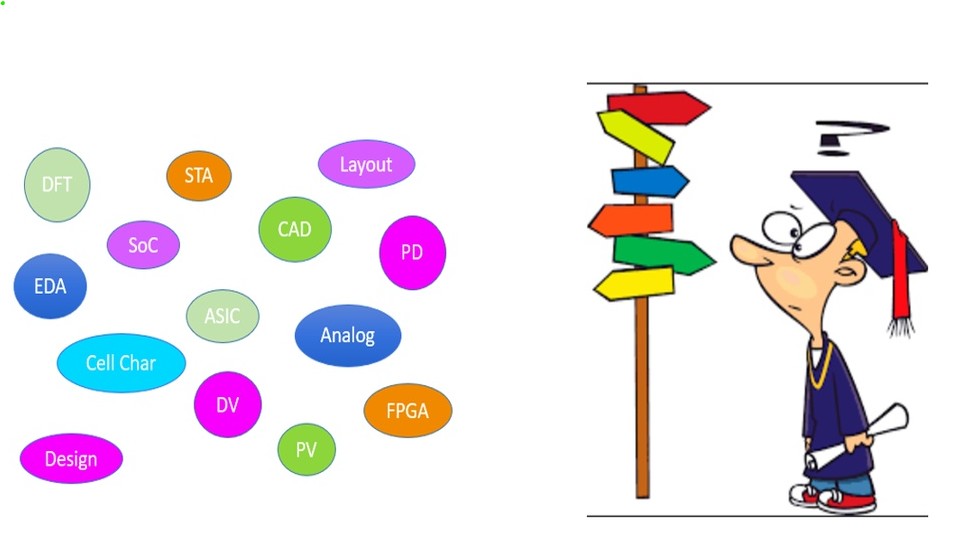
Are you searching for a VLSI courses that does more than just fill your head with theory? The truth is, the world of chip design is evolving faster than ever. For instance, in 2025, it’s not enough to just know the concepts; you need to prove your skills and stand out. Consequently, this guide will show you why the right VLSI courses are the most crucial investment you can make in your future.
The VLSI Industry in 2025: From Generalists to Specialists
The semiconductor industry is experiencing a new golden age. Everything from AI and machine learning to electric vehicles and the IoT, for example, drives an unprecedented demand for skilled engineers. However, the market has matured. Companies no longer look for generalists who know a little bit about everything. They now search for specialists who possess deep, hands-on expertise in specific, high-demand areas. Furthermore, the rise of generative AI is a game-changer. These tools automate parts of the design process, but they don’t replace the need for human expertise. Instead, they elevate the role of the engineer, thereby freeing you up to focus on more complex, high-value tasks. Therefore, this makes specialization more important than ever.
The demand for specialized skills is not a passing trend—it’s the new reality of the industry. The explosion of data, the miniaturization of technology, and the relentless drive for efficiency mean that companies need engineers who can solve highly specific, complex problems. Whether it’s designing a low-power circuit for a wearable device or optimizing the signal integrity of a high-speed data line, the challenges of modern chip design require a laser-focused skillset. General knowledge is the foundation, but specialization is, in fact, the key to a high-paying, secure career.
The Niche Advantage: While many VLSI courses cover the entire VLSI design flow, the real job opportunities are in specialized fields like Analog, Mixed-Signal, and RF IC Layout Design, as well as Physical Verification. These are the skills that, in particular, require a unique blend of technical knowledge and creative problem-solving.
The Power of First-Party Data: Your personal portfolio of project files, design layouts, and videos is, in a way, your most valuable asset. It’s unique to you and cannot be found anywhere else. This “first-party data” is, therefore, the ultimate proof of your skills and a key differentiator in a crowded job market.
Why a Specialized VLSI Course is Your Secret Weapon for Career Success
A specialized VLSI course is your blueprint for success. It’s designed to transform you from a beginner into an industry-ready professional in the most efficient way possible. In essence, it’s about moving from passively absorbing information to actively building your future.
Hands-On, Project-Based Learning for VLSI
Forget lectures and textbooks. The most effective VLSI courses are, after all, built around real-world projects. This type of training is vital because it:
Builds a Tangible Portfolio: You don’t just learn; you create a collection of projects that you can showcase to employers. This portfolio is, in effect, your proof of concept and a key differentiator. Your future employer doesn’t just want to hear that you know how to use a tool; they want to see your actual work. With a strong project portfolio, you can walk into any interview and say, “I’ve already done this.”
Develops Practical Skills: You will learn to use the same industry-standard tools (like those from Cadence and Synopsys) that professionals use every day. This hands-on experience means you can, in short, hit the ground running on day one. You won’t be stuck trying to figure out the software; instead, you’ll be focused on solving the design challenges.
Learning from Industry Veterans
A great course is only as good as its instructors. For this reason, you should look for a program led by experienced professionals who have worked on real-world chips. Their knowledge goes beyond theory and includes practical tips, best practices, and a deep understanding of what companies are truly looking for. Their expertise is your competitive advantage. They have seen the industry change and, as a result, know exactly what skills are needed for the future.
Semionics: Your Path to Becoming a Silicon Superstar with VLSI Courses
At Semionics, we build our VLSI courses on these principles. We are not a general training center; we are specialists dedicated to transforming you into a top-tier engineer in high-demand fields. For this reason, we provide:
Hyper-Focused Courses: We specialize in the most lucrative and intellectually rewarding niches in the industry. Our curriculum is fine-tuned to teach you the skills that employers seek. This focus allows us to provide a level of depth and practical insight that general VLSI courses simply cannot match.
Expert Instructors: Our team has over 18 years of experience, providing you with invaluable insights that are difficult to find anywhere else. They’ve tackled the very challenges you’ll face in your career, and they’re here to guide you every step of the way. Their mentorship is your secret weapon.
Practical, Project-Based Training: Our curriculum is centered on hands-on projects that build a portfolio you can use to impress potential employers. From your very first day, you’ll be working on real-world problems, building the skills and confidence you need to succeed.
A Glimpse into Your Future: The VLSI Career Path and Key Specializations
So, what does a career in VLSI look like after your training? The roles are diverse, collaborative, and offer high earning potential. With a solid foundation, you can move between these roles and, in addition, continue to grow your expertise.
The Layout Engineer: You are the architect. You take the circuit schematics and translate them into a physical layout, considering complex rules for power, signal integrity, and manufacturability. This role is a perfect blend of technical skill and creative problem-solving. It’s like building a city from the ground up, with every tiny detail mattering.
The Physical Verification Engineer: You are the quality control expert. You run sophisticated checks to ensure the design is flawless and ready for production. Your job is to catch the mistakes no one else can. A single error can cost a company millions, so this role requires a meticulous eye and a deep understanding of the entire design flow.
The CAD Engineer: You are the tool master. You help create and automate the design flow, making the lives of other engineers easier and more efficient. This is a role for those who love to optimize processes and build systems that scale. You’ll be at the forefront of automation, helping to shape the future of the industry.
The Final Quest: It’s Your Move
Ready to stop getting lost in the search results and start getting hired? Your journey into the exciting world of VLSI is just one click away. Stop thinking about “what if” and start building.
Semionics, Your Partner in semiconductor space , connecting industry needs with skilled professionals in Analog & Mixed-Signal IC Layout Design and Physical Verification ."from Basics to Brilliance .. A path to Semiconductor Industry!!"
We use cookies to improve your experience on our site. By using our site, you consent to cookies.
This website uses cookies
Websites store cookies to enhance functionality and personalise your experience. You can manage your preferences, but blocking some cookies may impact site performance and services.
Essential cookies enable basic functions and are necessary for the proper function of the website.
Name
Description
Duration
Cookie Preferences
This cookie is used to store the user's cookie consent preferences.
30 days
These cookies are needed for adding comments on this website.
Name
Description
Duration
comment_author
Used to track the user across multiple sessions.
Session
comment_author_email
Used to track the user across multiple sessions.
Session
comment_author_url
Used to track the user across multiple sessions.
Session
Statistics cookies collect information anonymously. This information helps us understand how visitors use our website.
Google Analytics is a powerful tool that tracks and analyzes website traffic for informed marketing decisions.
Used to determine whether a user is included in an A / B or Multivariate test.
18 months
_ga
ID used to identify users
2 years
_gali
Used by Google Analytics to determine which links on a page are being clicked
30 seconds
_ga_
ID used to identify users
2 years
_gid
ID used to identify users for 24 hours after last activity
24 hours
_gat
Used to monitor number of Google Analytics server requests when using Google Tag Manager
1 minute
_gac_
Contains information related to marketing campaigns of the user. These are shared with Google AdWords / Google Ads when the Google Ads and Google Analytics accounts are linked together.
90 days
__utma
ID used to identify users and sessions
2 years after last activity
__utmt
Used to monitor number of Google Analytics server requests
10 minutes
__utmb
Used to distinguish new sessions and visits. This cookie is set when the GA.js javascript library is loaded and there is no existing __utmb cookie. The cookie is updated every time data is sent to the Google Analytics server.
30 minutes after last activity
__utmc
Used only with old Urchin versions of Google Analytics and not with GA.js. Was used to distinguish between new sessions and visits at the end of a session.
End of session (browser)
__utmz
Contains information about the traffic source or campaign that directed user to the website. The cookie is set when the GA.js javascript is loaded and updated when data is sent to the Google Anaytics server
6 months after last activity
__utmv
Contains custom information set by the web developer via the _setCustomVar method in Google Analytics. This cookie is updated every time new data is sent to the Google Analytics server.
2 years after last activity
SourceBuster is used by WooCommerce for order attribution based on user source.
Name
Description
Duration
sbjs_session
The number of page views in this session and the current page path
30 minutes
sbjs_udata
Information about the visitor’s user agent, such as IP, the browser, and the device type
session
sbjs_first
Traffic origin information for the visitor’s first visit to your store (only applicable if the visitor returns before the session expires)
session
sbjs_current
Traffic origin information for the visitor’s current visit to your store
session
sbjs_first_add
Timestamp, referring URL, and entry page for your visitor’s first visit to your store (only applicable if the visitor returns before the session expires)
session
sbjs_current_add
Timestamp, referring URL, and entry page for your visitor’s current visit to your store
session
sbjs_migrations
Technical data to help with migrations between different versions of the tracking feature