Mastering Analog Layout Matching Techniques: A Crucial Step to Becoming an Efficient IC Layout Engineer

Shape Image One
Mastering Analog Layout Matching Techniques: A Crucial Step to Becoming an Efficient IC Layout Engineer

Why Analog Layout Matching Techniques Matter More Than Ever ?

In today’s era of deep submicron technologies and FinFET architectures, matching techniques in analog layout design are not just best practices — they are critical to circuit functionality. If your layout is not matched correctly, it can severely impact the current flow, voltage levels, and overall timing constraints of analog blocks like current mirrors, differential pairs, and biasing circuits.

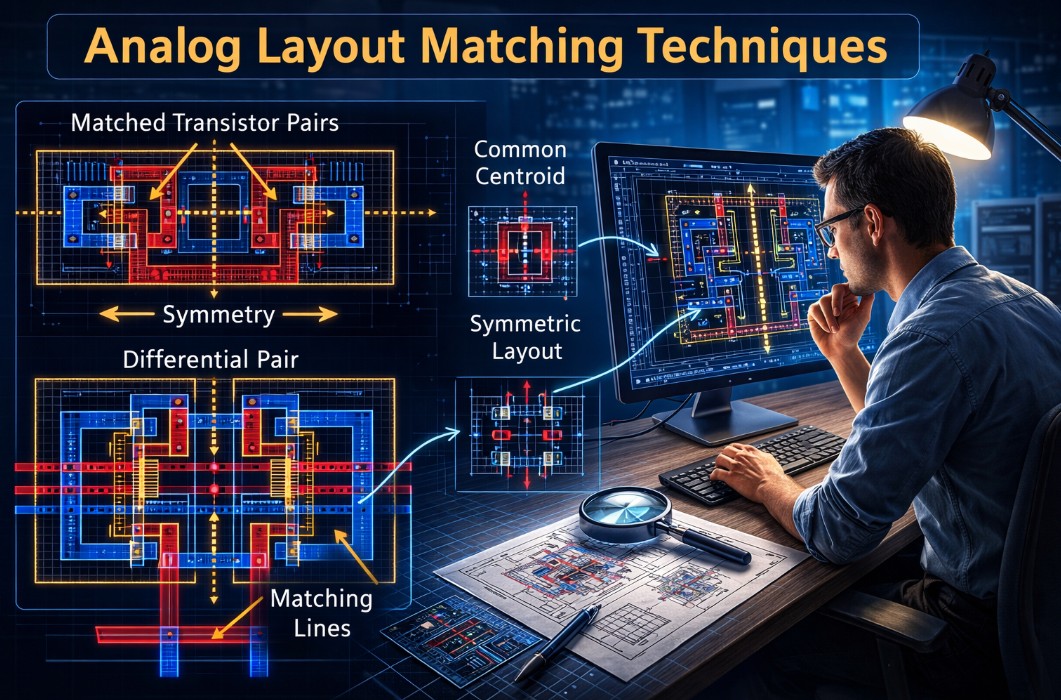
This blog dives into essential layout strategies like common centroid layout, interdigitation, orientation handling, and length matching, helping aspiring and experienced engineers avoid rework, reduce silicon failures, and meet foundry specifications effectively.

What Are Matching Techniques and Why Are They Important?

Matching in analog layout ensures that paired or multiple devices operate identically under real-world conditions. This is vital for:

  • Current mirrors: Unmatched layout leads to unequal currents and failed circuit biasing.
  • Differential pairs: Any mismatch introduces offset voltages, degrading precision.
  • Resistors, capacitors: Variation due to dispersion or proximity effects can alter timing or gain.

Poor matching can result in timing violations, degraded analog performance, increased power consumption, or even non-functional silicon. These risks amplify with shrinking nodes (65nm, 28nm, 7nm) and demand greater layout discipline.

Where Do You Use These Techniques?

Matching techniques are widely used in analog circuits like:

  • Op-amps
  • Bandgap references
  • ADCs / DACs
  • Bias generators
  • Voltage regulators
  • RF front-ends and PLLs

Each of these circuits demands high precision and zero tolerance for mismatch-induced errors. That’s where techniques like interdigitation, common centroid placement, and dispersion-aware routing become essential.

How Matching Affects Current, Voltage, and Timing ?

Improperly matched devices cause imbalances in analog blocks, affecting:

  • Currents – Inconsistent mirroring in current mirrors or sinking/sourcing errors.
  • Voltages – Differential pairs experience offset errors and gain mismatches.
  • Timing – Mismatched paths introduce skew and jitter, especially in high-speed designs.

A small difference in layout geometry can lead to substantial degradation in performance. This is why centroid placement, length matching, and orientation control must be part of every analog layout engineer’s toolkit.

Deep Submicron Impact: Why It’s Critical Today

In sub-65nm technologies and FinFET nodes, layout mismatches are no longer subtle. Even minor coincidence or orientation errors can introduce significant parasitics due to increased process variations. Without proper matching:

  • Threshold mismatches increase
  • Layout-dependent effects (LDEs) like stress, WPE, and proximity become more dominant
  • Device behavior becomes harder to predict and simulate

Mitigating these issues requires disciplined matching strategies, careful use of dummy devices, and consideration of multi-fin symmetry in FinFETs.

CMOS vs. FinFET Matching: What’s the Difference?

In CMOS, device matching is based on width/length ratios, symmetry, and dummy balancing. But FinFETs add new challenges:

  • Matching is quantized by the number of fins, not just drawn W/L.
  • Orientation (e.g., rotated devices) can dramatically affect stress and current.
  • Matching dispersion across rows becomes more critical due to layout-dependent variation.

Semionics’ advanced sessions cover the transition from CMOS to FinFET layouts — including how to adapt matching techniques accordingly.

Why Join the Semionics Matching Techniques Course?

This session is tailored for undergraduate students, master’s & Ph.D. researchers, and experienced layout professionals. Whether you’re just starting out or need to refine your matching strategies, this hands-on course will take your skills to the next level.

You’ll learn:

  • 📐 Common Centroid and Interdigitation techniques
  • 🧠 Tips and tricks to reduce layout rework
  • 🧪 Deep submicron effects and mitigation strategies
  • 📏 Routing techniques for length matching and orientation control
  • ⚠️ Matching precautions for FinFET vs CMOS

Industry-Backed, Expert-Led, Tool-Focused

Semionics courses are designed by working semiconductor professionals, offering unmatched insights into real-world design flows.

What you’ll get:

  • 🎯 Access to real-time test cases
  • 👨‍🏫 Sessions by industry veterans
  • 🔍 Lab exercises that mimic fab-ready scenarios
  • 🛠️ Use of standard EDA tools in all training modules

Join the Global Semiconductor Talent Networ

Semionics is actively building the semiconductor talent ecosystem in India and abroad by offering industry-ready VLSI courses. We’ve helped learners transition into layout roles at companies like Intel, AMD, Qualcomm, GlobalFoundries, and Synopsys.

🌐 With global accessibility and a tool-integrated Learning Management System (LMS), you can now learn analog layout from anywhere in the world.

What Our Learners Say ?

⭐⭐⭐⭐⭐ “The Matching Techniques session changed how I approach layout. I landed an internship thanks to this training.”
⭐⭐⭐⭐⭐ “I shared this course with my entire project team. The common centroid demo was a game-changer.”
⭐⭐⭐⭐⭐ “From dummy insertion to dispersion control — everything was practically explained. Semionics LMS is brilliant!”

Explore More and Upskill Further

We encourage learners to explore our full range of IC Layout courses, including:

  • Current Mirrors and Biasing Circuits
  • Analog Layout Isolation techniques
  • Physical Verification
  • DFM and IP Closure
  • Sanity and QA checks
  • Power Planning
  • Advanced Layout Editing concepts
  • Finfet Layout Guidelines
  • Technology Porting
  • and more …

Ready to Upskill?

🚀 Visit our LMS at www.semionics-academy.com
💬 Connect with us for course details, mentorship, and group learning programs.

📚 Share these sessions with your peers and colleagues — help grow the VLSI community with Semionics Academy.

Leave a Reply

Your email address will not be published. Required fields are marked *